Hull Performance, Vessel Performance & Fuel Modelling
Turning vessel operating data into practical insight on efficiency, performance and fuel use.
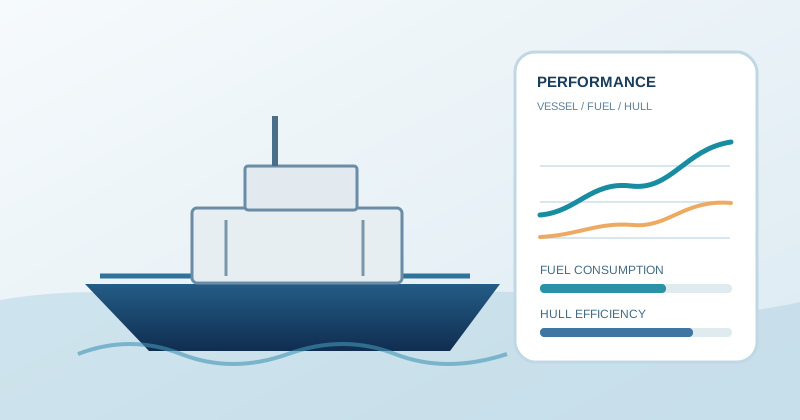
The challenge.
A standalone performance-intelligence capability spanning hull efficiency, vessel operating performance and fuel-consumption estimation. While these models can support weather-routing decisions, they also provide independent value for voyage monitoring, performance assessment and energy-efficiency initiatives.
Why this matters.
Vessel efficiency is not fixed. A ship's fuel consumption and achieved performance can vary with operating condition, environment and changes to the vessel over time. Making sense of those patterns matters for commercial operations, technical management and practical energy-efficiency decisions.
This work brings together three connected capabilities: hull performance, overall vessel performance, and fuel-consumption modelling. Together they support understanding how efficiently a vessel operates, comparing performance trends, and assessing expected fuel use across different operating conditions. The functionality stands on its own and can also complement weather-aware voyage planning.
From idea to working system.
Applied vessel-performance analytics, speed–power relationships, fuel models and data-driven performance assessment. The focus is on turning complex vessel behaviour into practical insights, monitoring views and useful model outputs. At the application level, this work connects engineering understanding, analytics and software delivery without exposing client-specific formulations or internal implementation details.
The practical benefit is clearer visibility into performance and fuel consumption. Operations and technical teams can use the outputs to assess deviations, discuss efficiency opportunities, support voyage and speed decisions, and understand how performance changes over time. Within weather routing, performance and fuel models help make route evaluations more vessel-specific; outside routing, they are independent tools for vessel analytics.
Practical applications.
Hull condition and performance trend visibility
Vessel efficiency and operational performance assessment
Fuel-consumption estimates for planning and monitoring
Independent vessel analytics that also enrich weather routing
Decision support for efficiency-focused operational discussions
Engineering highlights.
Monitoring changes in hull and overall vessel performance over time
Estimating fuel consumption across operating conditions
Connecting vessel-specific performance insight with voyage planning and operational decisions
Presenting performance trends through usable dashboards and decision-support services
Technical capabilities.
What it enables.
Clearer visibility into vessel efficiency
Support for performance monitoring and operational planning
Evidence for fuel-efficiency and maintenance discussions
Independent modelling capability that complements weather routing
Descriptions are high-level capability summaries. Client-specific designs, sensitive data, source code and proprietary implementation details are intentionally omitted.
Have a similar challenge?
I can help clarify the problem, choose a practical engineering approach and build toward a usable outcome.
Let's talk ↗Related work.

Weather Routing & Voyage Optimization↗
Turning dynamic weather and ocean conditions into practical voyage decisions.

Predictive Maintenance & Equipment Health↗
Using operational data to make equipment condition more understandable and actionable.

Marine Weather & Geospatial Intelligence↗
Engineering dependable spatial data services for environmental decision-making.
Have a problem that needs
more than a standard answer?
Let's discuss the problem, constraints and what a practical solution might look like.
Discuss your challenge ↗